



Finding a name in the Epstein files can take seconds. Understanding why it appears can take hours. Was it written in an address book, listed on a flight record, mentioned in a witness statement, or identified in a court finding? Those are different kinds of evidence. Treating them as interchangeable is how a search result becomes a misleading headline.
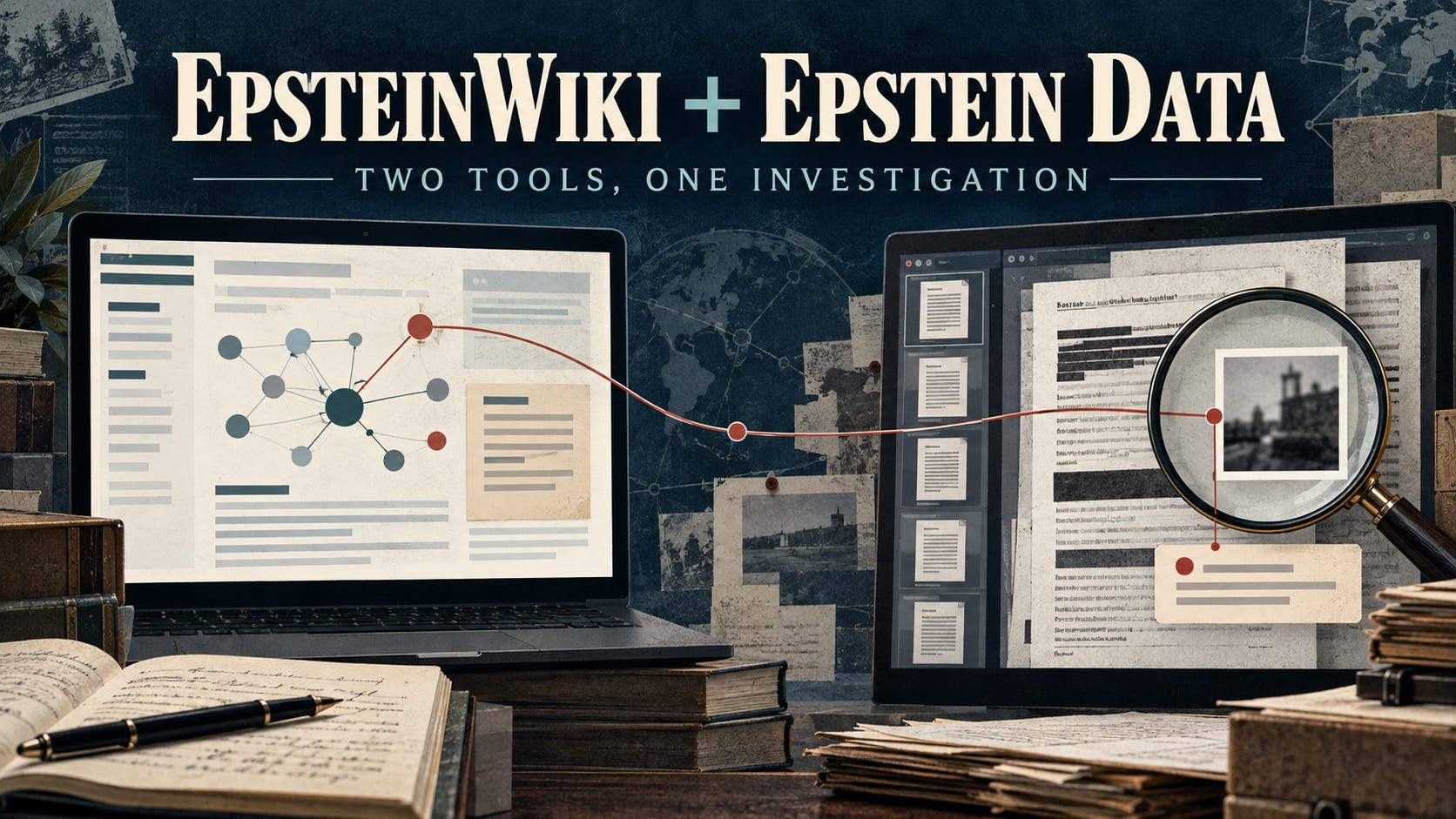
EpsteinWiki and Epstein Data work together to make that research more careful and accessible. EpsteinWiki organizes the story around people, institutions, places, cases, timelines, and evidence. Epstein Data helps readers search the underlying collections and inspect records. One supplies context. The other makes it easier to find and check the receipts.
The point is independent verification. A reader should be able to ask where a claim came from, inspect the relevant page, and decide whether the published interpretation holds up.
Snapshot
EpsteinWiki: A public knowledge archive that organizes research and explains the significance and limits of cited records and profiles the organizations and people involved in the Epstein case. In other words, EpsteinWiki fills in the important context missing from the document dumps.
Epstein Data: An independent searchable research database with document search, scanned records, flight data, transcripts, image tools, entity data, and links to source material.
How they work together: Start with a research question, read the Wiki for context, follow a source citation to Epstein Data, inspect the original record, and return to the Wiki with a better understanding of what the record does and does not show.
Essential safeguard: A search hit, extracted name, automated summary, or network connection is a lead. None is proof of criminal conduct on its own.
What EpsteinWiki Brings to the Investigation
The first article in this series explains why the Wiki exists: the public record is scattered across investigations, lawsuits, government releases, journalism, and archives. Someone looking for one institution may have to piece together a deposition, a later ruling, several emails, and a timeline of events. EpsteinWiki builds pages that put those materials into a coherent research path.
A Wiki page can tell you who a person is, which records refer to that person, when a relationship is documented, whether an assertion is an allegation or a court finding, and what remains unresolved. Case pages explain procedural history. Institutional and property pages connect records that otherwise appear in unrelated collections. The article should link a material claim to its source so a reader can check it.
That work involves interpretation, and interpretation needs discipline. The EpsteinWiki editorial standards prioritize primary documents, attribution, survivor dignity, and corrections. A biographical entry cannot turn an email mention into a criminal allegation. A timeline cannot silently turn an unverified tip into an established event. Context makes evidence useful only when the labels are honest.
What Epstein Data Brings to the Investigation
The Epstein Data document search lets readers look for keywords, quoted phrases, EFTA identifiers, and FBI serial numbers. Its search page also provides source and content filters. The site has separate collections for flight records, depositions, and searchable databases, among other research views. These tools can help a researcher find an item that a Wiki article cites or locate additional records that might challenge a draft conclusion.
The reverse image search offers another way in. A researcher can upload a photograph to search the released collections for visually similar images or use the site’s separate face search. This can help locate the source record for an image circulating without a citation. A visual or facial match is a lead to inspect, not proof of a person’s identity, a date, or a relationship.
An EFTA identifier is especially useful because it gives readers a precise way to seek a released record. But an identifier locates material; it does not certify that every assertion within that material is true. A released investigative file may contain a tip, a witness account, an allegation, a forwarded article, or a document whose meaning depends on neighboring pages.
Epstein Data also offers analytical reports and an AI research assistant. The site explicitly warns that its analytical text may contain errors and instructs readers to verify claims against linked EFTA source documents. That warning deserves to be followed. Searchable text may misread a scan, a transcription may omit context, and a generated summary may sound more certain than the page it summarizes.
A Practical Research Path Between the Two Sites
Suppose you see a claim that a particular person traveled on Epstein’s aircraft. Begin with a relevant EpsteinWiki person or flight article. Check the dates, the person’s identified role, the cited flight entries, and whether the article distinguishes a manifest entry from a confirmed trip.
Next, use the Epstein Data flight index or document search to find the cited entry. Record the aircraft, date, route, names as written, document identifier, and page. Look at the image where one is available, not only extracted text. Check the surrounding entries and any relevant corrections or alternate spellings. A handwritten initial may need more evidence before it can be assigned to a specific person.
Then return to the Wiki claim. Does the original record support the exact statement? Does it show a planned flight, a listed passenger, or a completed trip? Does it establish where someone went after landing? A flight record alone cannot answer what occurred at a destination. If the match remains uncertain, say so. The same method works for an email, photograph, appointment entry, financial record, or witness account.
For a quotation, compare the words to the visible page and cite its identifier and page number. For a serious allegation, identify who made it, when, in which proceeding or record, and whether independent evidence or a legal finding supports it. EpsteinWiki’s investigative standards explain why exact citations, image review, identity checks, and careful labels matter.
For an image, try Epstein Data’s reverse image search to find a candidate source. Open the matching record and check its EFTA number, caption or surrounding pages, and any independent information about its date and location. Do not identify someone from facial similarity alone. Avoid uploading a private person’s image or using the tool to investigate survivors.
What Each Kind of Record Can Tell You
An address book entry may show that contact information was recorded. It does not show that a call happened. An email can document a message, but not necessarily that its contents were accurate or acted on. A calendar entry may record an invitation or plan, not attendance. A flight log may record travel information without explaining the purpose of a trip. A witness statement reports what someone said. A court finding has a different status from a claim made in a complaint.
The EpsteinWiki research methodology asks contributors to gather and assess records across sources. Epstein Data makes many of those records searchable. The strongest work uses both: it finds the original item and then checks its type, date, provenance, surrounding pages, corroboration, and limits.
Even a match across several databases needs scrutiny. Multiple search results may derive from one duplicated document. A diagram may display a relationship because two names occurred in the same record. Automated entity matching may mistake one person for another. More dots on a screen do not necessarily mean more independent evidence.
Why Source Links and Corrections Matter
Every substantial EpsteinWiki evidence claim should give readers a route back to the source. When an EFTA record is available on Epstein Data, the citation should carry the complete identifier and a direct link. A court filing should identify the case, docket entry, and relevant page. Readers can then inspect the cited material and, where possible, compare it with an official release or court record.
That route also makes correction possible. If an OCR result misstates a name or a document changes the interpretation of a timeline, a reader can point to the exact page. The Wiki can correct its account while preserving the distinction between what the record says and what researchers inferred. Both sites are useful because the work remains open to checking, not because either site has the last word.
Survivor privacy belongs in this process. A public document may contain identifying details that need no further circulation. Responsible research can cite a record and discuss its evidentiary significance without republishing private information or turning a survivor’s account into spectacle.
Where to Begin
If you are new to the case, read What Is EpsteinWiki and Why Does It Exist? and choose a specific question: a date, case, institution, property, or document. Use the Wiki to learn the context and find cited sources. Use Epstein Data to inspect the underlying material. Save the exact identifier and page, and write down what the evidence establishes in one careful sentence.
That small habit changes the conversation. The answer becomes traceable. Other researchers can reproduce it, challenge it, or add to it. That is how an archive becomes useful to the public and accountable to the people whose lives are reflected in these records.
Now you have to start building TRUMPWIKI and see how the roads intersect!!