


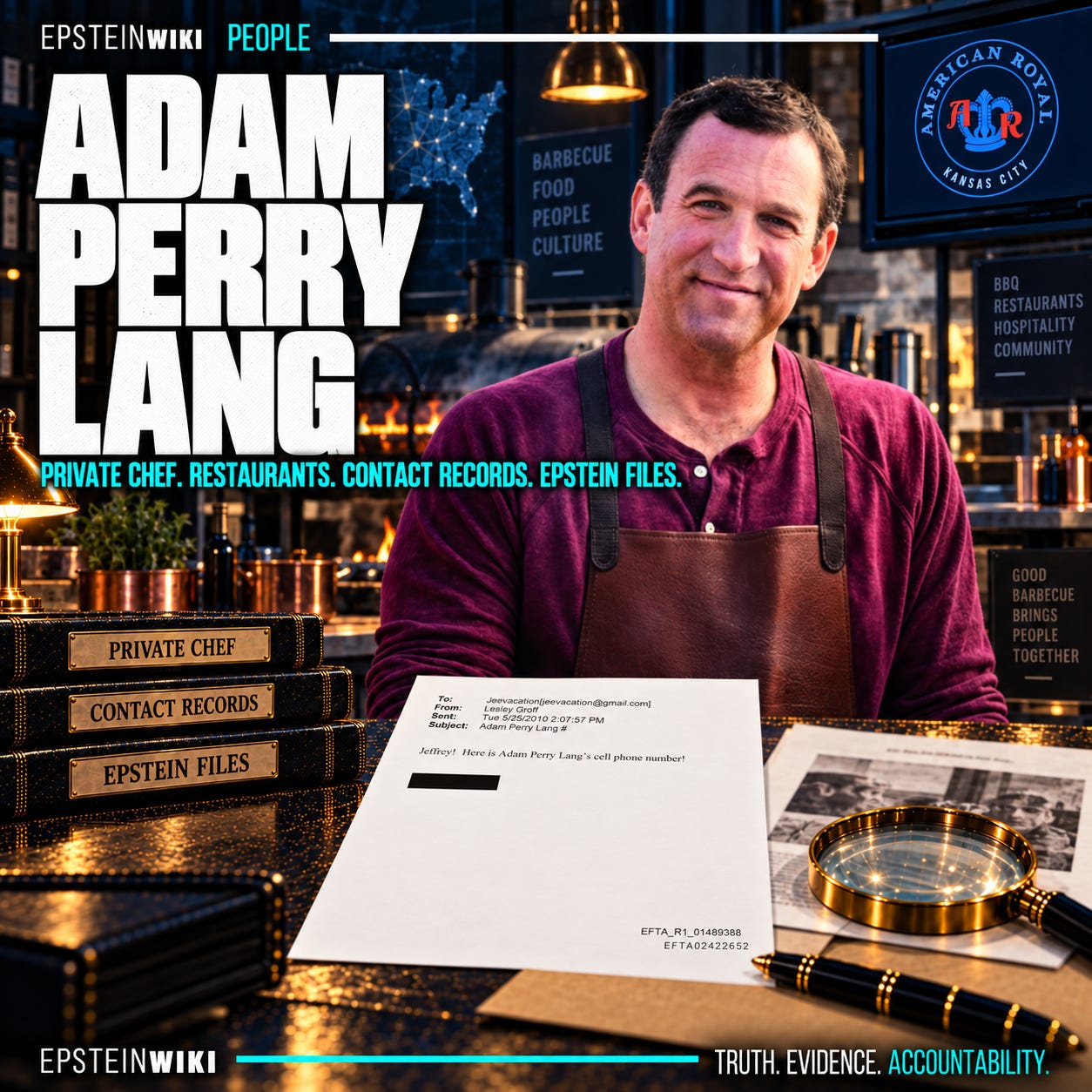
A private chef notices things.
He notices who arrives for breakfast, who stays for dinner, who needs food prepared for a flight, and who disappears upstairs. He knows when the household is full, when a guest arrives unexpectedly, when the boss is angry, and when young women begin appearing with unusual frequency.
Adam Perry Lang was not a caterer who worked one Epstein dinner. He was Jeffrey Epstein’s full time private and traveling chef for approximately four years. He cooked in Manhattan, Palm Beach, New Mexico, and the United States Virgin Islands. He prepared food for Epstein’s aircraft. He worked under Ghislaine Maxwell. He saw the guests, the staff, the massages, the young women, and at least one nude woman on Little St. James.
Yet when Lang finally acknowledged the employment relationship publicly in 2019, he presented his role as essentially confined to preparing food.
That version of the story is getting another hard look.
In a new video released today, Epstein researcher Ellie Leonard examines Lang’s place inside Epstein’s household and the distance between what he says he knew and what survivors say he could see.
The question is not whether Adam Perry Lang personally abused anyone. There is no public evidence that he did. The question is whether a man who spent years moving through Epstein’s homes and private island could truly have remained unaware of the environment surrounding him.
The Billionaire Nobody Named
Long before the public knew Lang had worked for Epstein, culinary profiles described him as a gifted young chef who had spent four years cooking for an unnamed billionaire.
Lang trained in elite kitchens before becoming known for barbecue. He later opened Daisy May’s BBQ USA, worked on major restaurant projects, partnered with Jamie Oliver, published cookbooks, and became a recognizable figure in the food world.
The mysterious billionaire remained unnamed until court records and reporting connected Lang to Epstein.
In September 2019, Lang confirmed the employment relationship. He said he had been a young chef when Epstein hired him, described his duties as meal preparation, and said he was unaware of Epstein’s depraved behavior.
It was a compact statement that made his role sound narrow and professionally distant.
The federal record tells a much larger story.
Hired by Ghislaine Maxwell
According to the FBI, Lang said Ghislaine Maxwell interviewed him for the job.
That detail confused him at the time. Epstein was supposedly the employer, but Maxwell conducted the interview and became Lang’s principal supervisor.
Lang initially thought Maxwell was Epstein’s girlfriend. After working inside the household, he came to see her more as an employee or manager.
Maxwell controlled Lang’s schedule, gave him instructions, and told him not to speak with Epstein’s guests. When she was unavailable, Lang could receive directions from other household personnel, including a woman identified as Lesley, apparently longtime Epstein assistant Lesley Groff.
Lang said he was effectively available around the clock. He carried a pager and could be summoned according to Epstein’s schedule.
That is not the description of a chef who floated into the kitchen, cooked a meal, and went home.
It is the description of a household insider.
The Kitchen Traveled With Epstein
Lang’s work followed Epstein across jurisdictions.
He cooked at Epstein’s Manhattan townhouse. He worked at the Palm Beach residence where police later documented the recruitment and abuse of teenage girls. He traveled to Zorro Ranch in New Mexico. He cooked on Little St. James, Epstein’s private island.
He also prepared food for Epstein’s aircraft and appears in travel evidence connected to Epstein’s planes.
Some flight records identify Lang by name or by the initials APL. Other entries use AP, which requires caution because those initials could also refer to interior designer Alberto Pinto.
One disputed December 14, 2000 entry lists Epstein, Maxwell, Virginia Roberts, and “AP?” An annotation proposes either Pinto or Lang. That entry cannot responsibly be called a confirmed Lang flight.
Other evidence is less ambiguous.
Published reporting identifies Lang aboard a May 12, 2000 flight from Teterboro to Palm Beach with Epstein, Maxwell, Prince Andrew, and additional redacted passengers.
Lang also told the FBI that he remembered Andrew in Florida and the Virgin Islands. He said Maxwell treated Andrew’s first visit as a major occasion.
The broader travel record is central to Ellie Leonard’s new video. Leonard argues that Lang repeatedly traveled to Little St. James over a period extending beyond the narrow image created by his 2019 statement.
The exact number of trips still needs to be reconciled against original pilot pages. What is not seriously disputed is that Lang traveled with Epstein’s household and worked on the island.
Virginia Giuffre Remembered Him
The most powerful evidence about Lang does not come from a restaurant profile or celebrity guest list.
It comes from Virginia Giuffre.
In her investigation of Epstein’s island operations, Leonard highlights a passage from Giuffre’s memoir, Nobody’s Girl.
Giuffre wrote, “I liked Lang because he treated me and Epstein’s other girls as human beings.”
She remembered that even when she stood naked in front of him, Lang looked her in the eye instead of staring at her body.
It is a devastating detail precisely because it contains kindness.
Giuffre was not describing Lang as one of her sexual abusers. She was remembering a man who treated her with a degree of dignity inside a place where dignity had become unusual.
But the memory creates a question that cannot be brushed aside.
If Giuffre stood naked in front of Lang, then Lang’s exposure to Epstein’s environment was not confined to plates, cutting boards, and grocery orders.
He saw the girls.
He spoke with them.
At least one of them remembered his behavior decades later.
Giuffre’s recollection does not prove that Lang knew her age, understood that she was being trafficked, or knew what Epstein and Maxwell were doing behind closed doors. It does make the phrase “limited to meal preparation” feel painfully incomplete.
The Survivor Who Knocked on His Door
Giuffre did not merely remember Lang. She tried to obtain his help.
In Giuffre v. Maxwell, Lang appeared on a proposed witness list as Epstein and Maxwell’s traveling chef. Giuffre’s lawyers said he might possess information about the alleged trafficking operation and interactions involving underage minors.
That was a litigant’s assertion, not a judicial finding. Still, it shows that Giuffre and her legal team believed Lang could corroborate important parts of her account.
Journalist Tara Palmeri later documented how Giuffre traveled to Los Angeles and tried to persuade Lang to provide an affidavit.
She asked him to help her.
Lang communicated through lawyers. He did not provide the affidavit Giuffre wanted.
Again, lawyering up does not make someone guilty. A person facing media attention and possible involvement in major litigation has every right to obtain counsel.
But the human reality remains.
A survivor crossed the country looking for someone who had seen her inside Epstein’s world. She believed his memory could help establish that she had been there and that her account was true.
She left without his affidavit.
What Lang Told the FBI
Federal investigators interviewed Lang by video conference on September 25, 2020. The interview was attended by prosecutors, an investigator, an FBI agent, Lang, and his attorneys.
The resulting five page FBI report appears in EFTA01246710, EFTA01246711, EFTA01246712, EFTA01246713, and EFTA01246714.
Lang told investigators that he worked full time for Epstein from approximately 1998 through 2002. He reported primarily to Maxwell and was available through a pager.
He acknowledged seeing young women around Epstein. He said he would not describe them as minors, but they appeared young enough to give him what he called a college girl impression.
Visual estimates are not age verification.
Epstein’s operation was built around making exploitation look routine. Teenage girls entered a wealthy household where adults, employees, drivers, pilots, assistants, and famous visitors continued with their work. A vulnerable sixteen year old could be made to look like another young assistant, massage student, girlfriend, or guest.
Lang also told investigators that massages were a major part of Epstein’s life. He remembered women arriving and interacting with a principal house manager.
When investigators asked about nudity, Lang acknowledged seeing an unidentified nude woman while he was grilling on Little St. James.
Giuffre’s memoir adds survivor context that the FBI summary does not resolve.
Was the woman Giuffre? Was she someone else? Did Lang see more than one nude young woman? Did he recognize Giuffre when investigators later questioned him?
The released FBI report does not answer those questions.
The Famous Men at the Table
Lang remembered serving or encountering several prominent people in Epstein’s orbit.
He told investigators that Bill Clinton had been aboard an aircraft and once ate food directly from Lang’s cutting board. He remembered Prince Andrew in Florida and the Virgin Islands. He identified Larry Summers and Nathan Myhrvold as guests. He recalled members of the Dubin family traveling aboard Epstein’s aircraft.
Lang also said Donald Trump attended dinner at Epstein’s Manhattan townhouse on one occasion.
A meal, flight, or social visit does not prove that any named guest knew about Epstein’s abuse. The names matter because they help reconstruct Epstein’s social environment and because Lang was positioned to observe that environment firsthand.
He knew who needed dinner.
He knew who needed aircraft food.
He knew when Maxwell considered a visitor important.
That kind of knowledge is why household employees matter to an investigation.
The Rules of the House
Lang’s FBI account also described a culture of control.
Maxwell instructed him not to speak with guests. When one guest asked Lang about real estate and Lang answered, he suspected the exchange might have been a test. Maxwell reportedly stopped speaking to him for approximately a day afterward.
In another incident, Lang requested personal time and prepared food in advance. Maxwell called and yelled at him. She ordered him to apologize and told him Epstein wanted to see him the next morning.
Lang remembered Epstein as aggressive, intense, and frightening during the confrontation.
He also said he signed a nondisclosure agreement before beginning the job.
None of those facts proves Lang knew about sexual abuse. Together, they describe a household where employees were closely managed, communication was restricted, privacy was formalized, and displeasing Epstein could feel threatening.
That structure matters because silence rarely grows from a single instruction. It grows from repeated lessons about what happens when someone asks questions, talks to the wrong person, or steps outside an assigned role.
Law Enforcement Was Interested Years Earlier
The 2020 interview was not the first time investigators showed interest in Lang.
An EFTA evidence inventory lists a 2006 law enforcement report concerning him, December 2006 searches under his name, and another law enforcement record from August 2007.
Those entries appear in EFTA00095751, alongside the later attorney contacts and 2020 interview materials.
The inventory does not say Lang was suspected of a crime. Former household employees were logical witnesses.
Lang also told investigators that he had spoken with a female FBI agent before Epstein’s 2008 Florida conviction. Near the end of that conversation, he said, the agent told him the inquiry concerned sex trafficking.
That means Lang knew during the original investigation that federal agents were examining trafficking allegations involving his former employer.
The contents of his earlier statement remain unclear.
His Public Story and His FBI Story
Lang’s 2019 statement said his role was limited to preparing meals.
His 2020 FBI account described four years of full time employment, constant availability, travel across four major Epstein properties, aircraft service, young women, massages, nudity, restrictive supervision, a nondisclosure agreement, frightening behavior, and prominent guests.
Those accounts can technically coexist. A chef can witness disturbing conditions without understanding the criminal system behind them.
But they do not create the same picture.
“Meal preparation” sounds removed.
The FBI account sounds embedded.
This is why Leonard’s video matters. It asks viewers to stop treating household labor as background scenery. The people who cooked, drove, scheduled, cleaned, flew, managed, and answered phones were part of the physical infrastructure that kept Epstein’s world functioning.
That does not make every employee a coconspirator.
It does make them witnesses.
Kindness Is Not the Same as Innocence
Giuffre’s memory of Lang should not be flattened into either condemnation or absolution.
She remembered him being kind.
She also wanted his testimony.
Those facts belong together.
A man can treat a girl gently while failing to ask why she is naked in his employer’s home. An employee can feel intimidated while still observing details that could help a survivor. A person can be innocent of direct abuse while possessing information that matters enormously to accountability.
The hardest questions in the Epstein case often live in this space.
Who saw enough to wonder?
Who suspected but stayed quiet?
Who convinced themselves that the young women were adults?
Who followed the rules because the employer was powerful?
Who later reduced years of access to a single job description?
And who, when a survivor came asking for help, chose the protection of lawyers over the vulnerability of an affidavit?
These are not rhetorical declarations of guilt. They are questions demanded by the evidence.
What We Know and What We Do Not
There is no public evidence that Adam Perry Lang sexually abused Giuffre or another survivor. He has not been charged with an Epstein related crime.
There is also no serious dispute that he worked inside Epstein’s household for years, traveled to Epstein’s properties, saw young women, knew about the constant massages, observed nudity, and interacted with the people inside that world.
The unresolved issue is knowledge.
What did he understand at the time?
What did he tell the FBI during the original investigation?
What did he remember about Giuffre?
What did he disclose in 2020 that never appeared in the five page summary?
What records, photographs, menus, schedules, receipts, or travel details might still exist?
And why did a survivor believe his affidavit could help prove her story?
The People in the Background Were Never Background
Epstein’s operation required houses, aircraft, calendars, drivers, assistants, pilots, cleaners, chefs, and people willing to enforce the boundaries between one part of the household and another.
The abuse did not occur in an empty room floating outside ordinary life.
It happened inside a functioning system.
Someone bought the groceries. Someone prepared the bedrooms. Someone scheduled the flights. Someone answered the phones. Someone cooked for the powerful men at the table while girls moved through the same properties.
Ellie Leonard’s video about Adam Perry Lang forces us to look directly at one of those people in the background.
Giuffre remembered him because he looked her in the eye.
Now the public must look at the evidence with the same clarity.
Sources
Tara Palmeri, “What Virginia Giuffre Taught Me About Being Believed”
Eater, “Barbecue Star Adam Perry Lang Confirms That He Once Worked for Jeffrey Epstein”
Eater Los Angeles, “Podcast Details Adam Perry Lang’s Stint as Jeffrey Epstein’s Private Chef”
David Rodgers deposition material in Case 18-2868, Document 279
Absolutely gripping summary of who may have seen what ..... and when & where. I was mesmerized because these are questions I've been asking myself ever since I first found Tara Palmeri on Substack. I felt so sad & angry when I heard that some former Epstein employee's slammed their door when Virginia identified herself ! I cried. I wondered how they could be so cruel. Sometimes I felt sad because I suspected they had been threatened, so I fluctuated between sadness & anger.
I'm thankful for writing like this & for Ellie & Tara & the thousands of Journalists (Independent, Citizen or Professional.) who are covering this story for mainly altruistic aims. You people, for the most part, are showing your true intentions ! They show real good, honest, moral intentions & an admirable work ethic. Thank you. Thank you. Thank you . Go getum' !
How ridiculous it is to say he didn’t know what Epstein was up to.
Eyes, ears, and a brain is all it takes.