


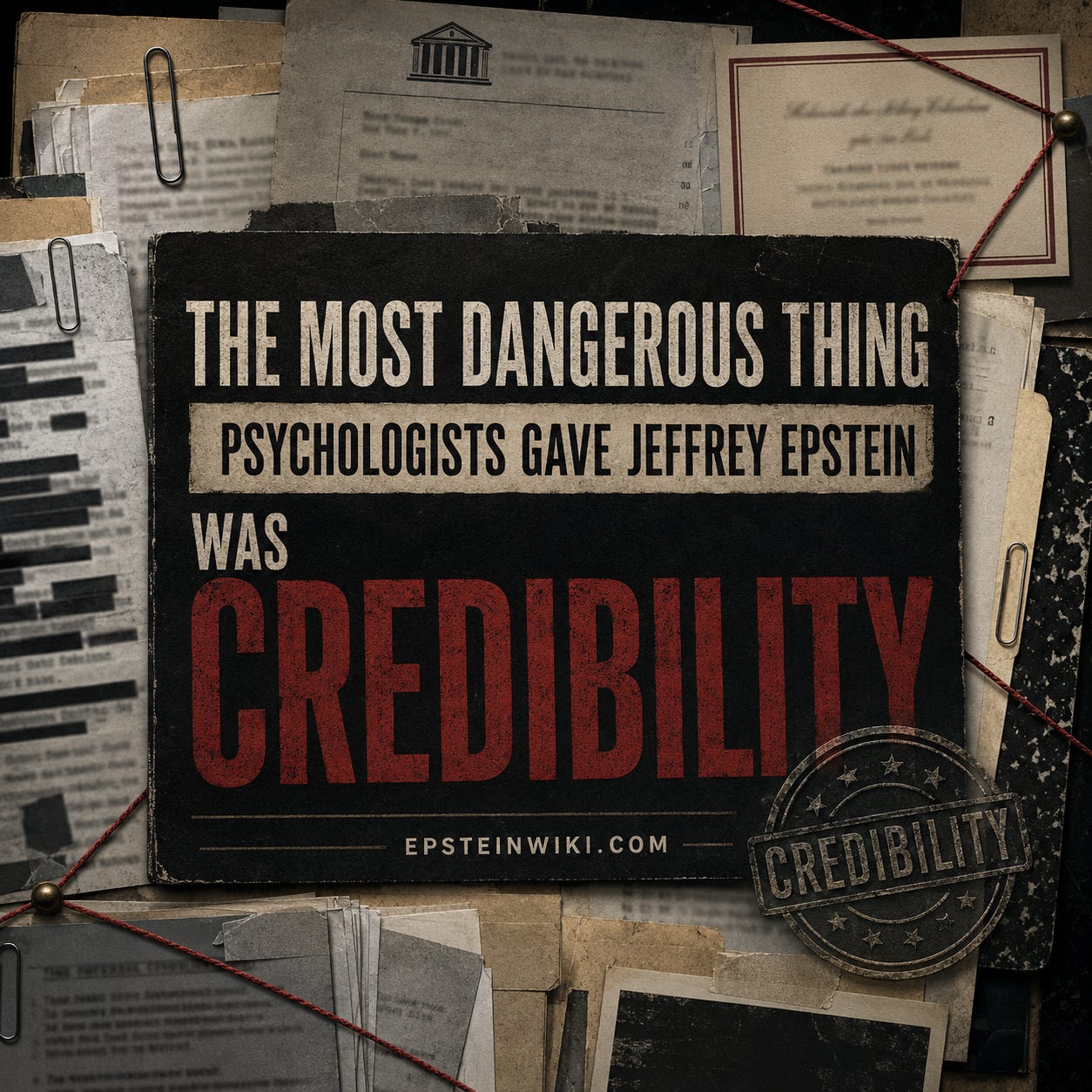
A mental health professional examines how clinical authority, academic prestige, money, referrals, and continued access helped a convicted sex offender remain welcome among people trained to understand manipulation and harm
I have spent my career helping people understand trauma, coercion, abuse, and the ways powerful people manipulate victims and witnesses. That is why the records connecting Jeffrey Epstein to psychologists, psychiatrists, and behavioral scientists horrify me.
Not every psychologist named in the Epstein files committed a crime. Some appear only on a proposed invitation list. Others had limited professional contact or attended a donor event before Epstein’s crimes were publicly known.
But our EpsteinWiki investigation documents something larger than a list of famous names.
Epstein accumulated credibility from people whose professions gave them unusual authority to define intelligence, character, risk, rehabilitation, and human behavior. Some accepted his money. Some gave him access to academic institutions. Some continued answering him after his conviction. One supplied a remarkably favorable clinical opinion. Another treated a woman Epstein referred and helped pay for. Others became part of the intellectual scenery surrounding him.
Epstein did not need every person in that network to know what he was doing. He needed their reputations.
A Harvard Credential for an Unqualified Donor
Stephen Kosslyn was not a marginal academic. He chaired Harvard’s Psychology Department and served as dean of social science. Harvard’s own review found that Epstein donated $200,000 to support Kosslyn’s work between 1998 and 2002.
Then, in 2005, Kosslyn recommended Epstein for admission as a Harvard Visiting Fellow.
Harvard later concluded that Epstein lacked the qualifications normally possessed by Visiting Fellows and proposed a course of study he was not qualified to pursue. The application nevertheless succeeded because a department chair supported it. The paperwork did not disclose the Epstein funding connected to Kosslyn’s research.
That transformed a wealthy donor into a person with a Harvard academic affiliation.
The relationship did not end when Epstein became a convicted sex offender. Kosslyn visited him while he was incarcerated and remained in contact afterward. In 2011, he drafted possible language Epstein could use when questioned about his criminal history. The actual email framed Epstein as someone who had paid his debt and should be allowed to rebuild his life.
That is reputation work.
It is an example of how prestige laundering functions. A respected professional need not publicly declare an offender safe. He can keep taking calls, drafting language, extending invitations, or providing access to new circles.
Each act tells everyone watching that the offender still belongs.
A Convicted Sex Offender Asked for a Child Psychologist
One of the most troubling records is also one of the easiest to exaggerate.
In January 2010, Epstein asked Kosslyn whether “Robin” could identify a child psychologist in New York for an unidentified 15 year old girl described as having obsessive compulsive behavior. Kosslyn forwarded the request. Robin said she did not know child therapists in New York, mentioned a provider found online, and offered to ask others.
You can read the correspondence yourself.
The email does not call the desired clinician “discreet.” It does not identify the girl as trafficked. It does not prove that an appointment occurred. Those additions have circulated online, but they are not in the document.
The verified fact is alarming enough.
A convicted sex offender was privately trying to arrange mental health care for a minor through a prominent academic friend. The record does not explain who the girl was, whether a guardian consented, why Epstein was involved, who would pay, or whether he expected access to information about her treatment.
As a mental health professional, I do not need invented details to understand why those unanswered questions matter.
The Psychologist Who Said Epstein Was Unlikely to Reoffend
Stephen R. Alexander was Epstein’s treating psychologist. In August 2010, Alexander wrote to Epstein attorney Jack Goldberger and offered an extraordinarily favorable assessment.
Alexander said Epstein had benefited from treatment, posed no threat to himself or the community, had learned his lesson, had a negligible probability of reoffending, and required no additional treatment.
That opinion carried the authority of a licensed psychologist. It also came from a clinician whose relationship with Epstein extended beyond a clean therapeutic boundary.
The released records document financial dealings, personal warmth, family favors, and requests for Epstein’s assistance. In one exchange involving remaining investment funds, Alexander acknowledged that the money was Epstein’s and thanked him for sharing it. That email is preserved here.
The records do not prove Alexander intentionally falsified his clinical opinion. They do raise obvious questions about independence, conflicts, disclosure, and the foundation for his prediction.
When clinical authority is used to say that a dangerous person poses little risk, the supporting methods and relationships deserve scrutiny.
When a Research Misconduct Crisis Led Back to Epstein
Marc Hauser was a Harvard psychologist whose career collapsed after Harvard found him responsible for eight instances of scientific misconduct. The federal Office of Research Integrity later made its own research misconduct findings.
During that crisis, Hauser remained in contact with Epstein and sought his advice. In one email, Hauser sent Epstein proofs of a research paper and wrote that Epstein’s money had been “very well spent here.” The receipt is direct.
Other messages show Epstein advising Hauser on how to respond to the scandal, Hauser discussing Harvard leadership with him, and Hauser exploring projects and possible funding.
The misconduct findings are separate from Epstein. The files do not show that Epstein caused them. They show that after Epstein’s conviction, a Harvard professor facing an ethics crisis still treated him as an adviser, patron, and useful connection.
That is what normalization looks like.
Epstein Could Become the Gateway to Treatment
The records involving psychiatrist Paul Conti reveal a different kind of power.
In 2015, Conti thanked Peter Attia for reconnecting him with Epstein and told Epstein he welcomed the opportunity to help Epstein’s friend. That exchange appears here.
Willamette Week later reported that financial records showed more than $30,000 in payments from Epstein’s accounts to Conti’s practice through June 2017. Conti told the publication that Epstein introduced him to a woman in severe distress and that he continued treating her without charge after Epstein stopped paying. The reporting also described correspondence in which Conti gave Epstein general updates about her progress.
There is no public finding that Conti committed a crime or violated a licensing rule. The patient’s identity and clinical privacy should be protected.
But the ethical questions are unavoidable. Did the patient understand the financial relationship? What releases existed? What information did Epstein receive? Could the person paying for care exercise influence over treatment or access?
An alleged abuser becoming the gatekeeper and payer for another person’s mental health care creates a power structure no ethical institution should ignore.
Not Every Name Is Evidence of Enabling
Our investigation also found people whose records are much narrower.
Daniel Gilbert had documented meetings and friendly professional exchanges with Epstein, but we found no evidence that he treated minors, received Epstein funding, or assisted his legal defense. Alfonso Caramazza and Steven Hyman attended a 2003 Harvard donor dinner before Epstein’s arrest, but the available record does not establish a personal relationship or consequential assistance. Several other prominent names appeared only on a proposed gathering list.
Those distinctions make the investigation credible.
A list mention is not a meeting. A proposed meeting is not a completed meeting. Contact is not funding. Funding is not knowledge of abuse. An allegation is not a finding. A duplicate document is not a second event.
When we overstate weak evidence, we hand defenders a reason to dismiss strong evidence.
And the strong evidence here is devastating.
The Profession Must Confront What Its Credibility Can Do
Mental health professionals are trained to recognize grooming, coercive control, impression management, boundary violations, exploitation, and conflicts of interest. We understand that dangerous people rarely present themselves as dangerous. They cultivate witnesses who can say they seemed brilliant, generous, curious, rehabilitated, or safe.
Epstein surrounded himself with people capable of supplying exactly those impressions.
Some gave him academic legitimacy. Some gave him clinical language. Some accepted his patronage. Some kept him connected to prestigious rooms. Some became pathways to vulnerable people seeking care.
Psychology did not cause Epstein’s crimes. Professional credibility can still become protection when expertise is separated from accountability.
Survivors were required to prove and repeat what happened to them. Epstein needed only to keep enough impressive people in his orbit that others would doubt, minimize, compartmentalize, or look away.
That is the system we are documenting.
Read the complete EpsteinWiki investigation, examine the primary records, and follow the individual dossiers. Do not settle for viral lists or guilt by association. The documented truth is more precise, more disturbing, and much harder for powerful institutions to explain away.