


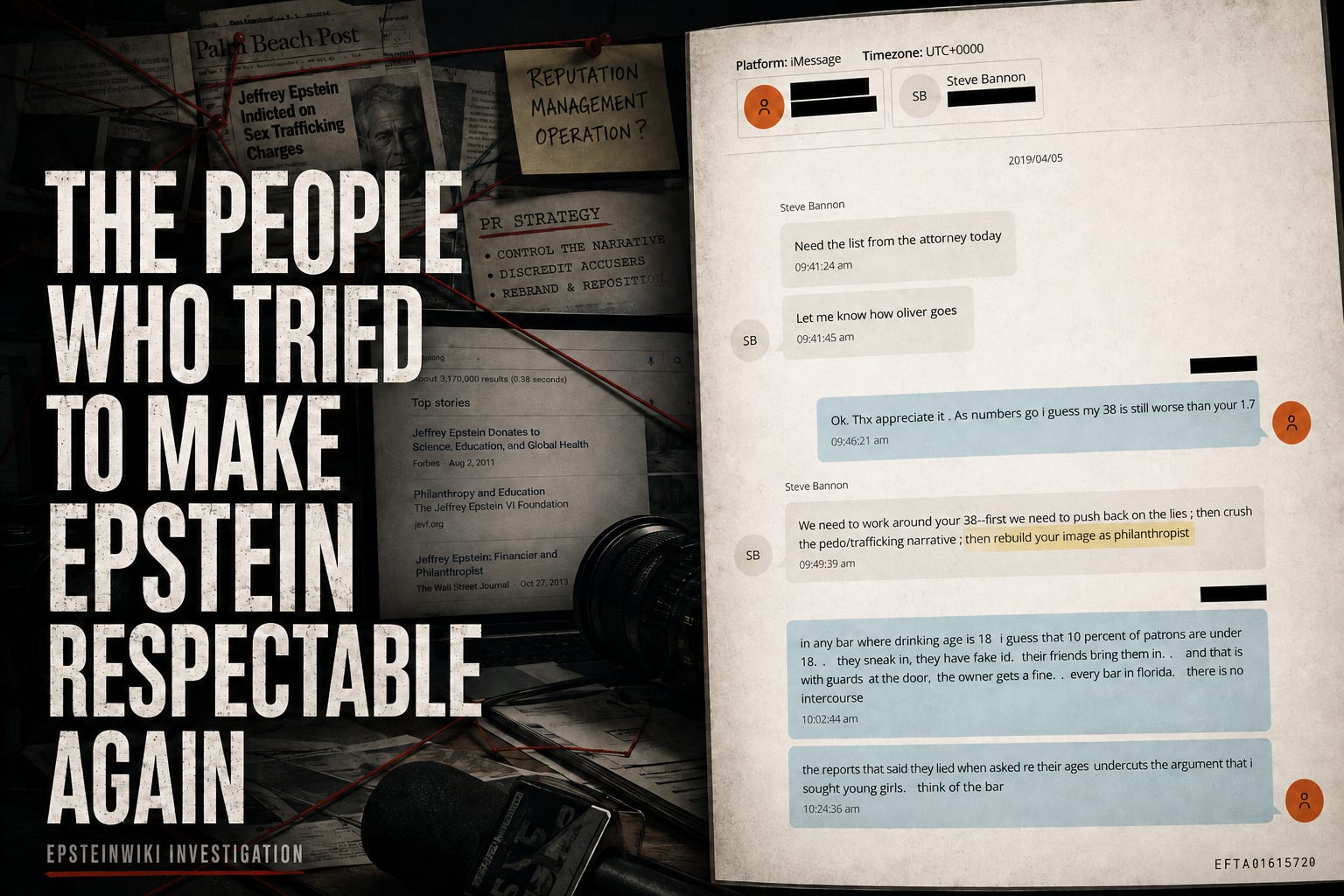
Jeffrey Epstein did not just hire lawyers.
He built a machine designed to make you doubt what you already knew.
After pleading guilty in 2008 to felony solicitation of prostitution and procuring a person under eighteen for prostitution, Epstein faced a problem money alone could not erase. Anyone who searched his name could find the conviction, the allegations, and the women who had begun describing what happened to them.
So Epstein set out to change what the public encountered first.
He hired publicists. He approached crisis specialists. He paid search consultants. He cultivated journalists. He surrounded himself with scientists, academics, celebrities, and political figures whose reputations could be borrowed to soften his own.
He did not need to prove that the survivors were wrong.
He needed to make the truth harder to find.
First, Get Their Story Out
Publicist Dan Klores was working for Epstein while the Palm Beach case was still unfolding.
A contemporaneous news report preserved in EFTA00189976 identified Klores as Epstein’s publicist and quoted him saying that Epstein’s camp was ready to present its side of the story.
A January 2007 bank record in EFTA01526846 identifies a transfer from Epstein’s account to Dan Klores Communications. The Hollywood Reporter reported that the payment was $10,000.
Epstein later worked with Howard Rubenstein, the legendary New York publicist sometimes described as the dean of damage control.
When reporters had questions about Epstein, they went through Rubenstein. A Daily News inquiry sent directly to him appears in HOUSE_OVERSIGHT_031099.
Rubenstein reportedly told the New York Post that Epstein had no business relationship with Jean Luc Brunel or Brunel’s MC2 Model Management.
Later evidence showed that Epstein provided substantial financial backing to Brunel and MC2.
That was the model. Deny the relationship. Redirect the question. Create enough distance between the public and the underlying evidence that uncertainty could do the rest.
Clean the Google Page
By 2010, Epstein’s problem was no longer limited to newspapers.
It was Google.
In an email to Al Seckel, Epstein stated the objective with remarkable clarity. He did not want a broad charitable program. He wanted his Google page cleaned.
That message appears in EFTA02417871.
Seckel became deeply involved in the project. In EFTA00754095, he told Epstein that the first page of Yahoo results had been cleaned. He explained that Yahoo was easier to manipulate than Google.
In EFTA00753570, Seckel discussed pushing favorable material onto the first page and getting rid of the rest.
The work extended beyond search results. In EFTA02685766, Seckel referred to attempts to fix Wikipedia and said automated systems had begun collecting material created by the campaign.
This was not passive reputation monitoring. It was an attempt to manipulate the information environment surrounding a convicted sex offender.
If the first page showed philanthropy, science, and academic conferences, fewer people would continue searching for the police reports.
The Reputation Companies Arrive
In February 2012, Epstein approved the purchase of an advanced package from Integrity Defenders.
The proposed package cost approximately $2,449 plus tax. Epstein’s approval appears in EFTA00928789. The company’s invoice followed in EFTA00420051.
A few months later, Reputation Changer produced an even more aggressive proposal.
The ten page plan begins with EFTA01176548. It proposed filling the first four pages of Google, Bing, and Yahoo with favorable material about Jeffrey Epstein.
The campaign would use articles, press releases, blogs, social media profiles, independent websites, and backlinks. The price was $7,500 for the first month and $5,000 for each later month.
Epstein’s calendar later recorded a call with the company’s chief executive and head of technology in EFTA02158791.
The documents establish a proposal and continuing discussions. They do not establish the total amount Epstein may have paid.
Reputation Changer later became Brand.com. It ceased operating after bankruptcy in 2015.
This industry did not invent Epstein’s preferred identity. It industrialized it.
Turn a Convicted Sex Offender Into a Science Patron
The reputation campaigns repeatedly returned to one subject: science.
Publicist R. Couri Hay proposed rebuilding Epstein’s image through scientists, prestigious institutions, and carefully arranged photographs.
In EFTA02420876, Hay asked whether Epstein was ready to discuss repairing his reputation slowly and strategically.
The proposed campaign reportedly cost between $15,000 and $20,000 per month. It contemplated photographs with prominent scientists and even the creation of a prestigious mathematics prize.
Hay ultimately declined to represent Epstein. That distinction matters.
Ian Osborne went further.
In EFTA00915695, Osborne sent Epstein a client agreement, measures of success, and a strategy document. Journalist Michael Wolff was copied.
Epstein’s own internal records later categorized Osborne under reputation management in EFTA00299927.
The strategy sought to improve search results and reestablish Epstein as a supporter of science and technology. It contemplated outreach to editors, columnists, and financial journalists.
Science was useful because it offered borrowed credibility.
A flattering article on Epstein’s own website was obvious propaganda. A university biography, conference announcement, or scientist’s page could look independent while helping push damaging material lower in search results.
Every respected person who entered Epstein’s home after his conviction added another layer of normalization.
The Article Placements
Technology entrepreneur Pablos Holman introduced Tyler Shears to Epstein, according to Forbes.
The resulting communications are difficult to dismiss as casual networking.
In EFTA01217753, Shears told Epstein that he could obtain another Forbes placement.
In EFTA01217770, Shears referred to three placements and an editorial position.
When an unfavorable Fox article appeared, Epstein and Shears discussed it in EFTA01217753.
Websites associated with the campaign presented Epstein as a financier, philanthropist, intellectual, and supporter of scientific research.
A favorable Forbes contributor article was amplified. Forbes removed it in 2019 after determining that it did not meet editorial standards.
Forbes reported that Epstein paid Shears at least $50,000.
The Celebrity Publicists
Epstein cycled through some of the most experienced crisis specialists in the business.
Merrie Spaeth helped him prepare a possible public apology and coached him on anticipated questions, according to reporting based on his emails. She later said she ended the engagement because she was uncomfortable with it.
But the contact continued.
In EFTA02087402, Spaeth reached out during renewed negative publicity in 2015 and said she wanted Epstein to know he had friends thinking about him.
Mike Sitrick also worked directly for Epstein.
Correspondence in EFTA00682221 and EFTA00682226 shows Sitrick discussing legal records, Epstein’s conviction, and media strategy.
The work focused partly on the expanding scandal surrounding Prince Andrew. Epstein acknowledged that several articles had been stopped and another softened, yet complained that his reputation was still being damaged.
Then Epstein stopped paying.
Sitrick sued and obtained a default judgment of approximately $155,000 in 2015.
Matthew Hiltzik entered the picture later. Reporting indicates that Hiltzik charged Epstein $25,000 per month.
When Epstein circulated a proposed defense after the Miami Herald investigation revived the case in 2018, Hiltzik advised that it needed a sentence confirming Epstein understood that he had done something wrong.
That advice appears in HOUSE_OVERSIGHT_030255.
Hiltzik says he ended the relationship after Epstein rejected advice to accept responsibility.
Apparently, Epstein wanted rehabilitation without accountability.
Peggy Siegal and the Power of the Guest List
Not every reputation service looked like a press release.
Sometimes it looked like dinner.
Entertainment publicist Peggy Siegal helped bring prominent guests into Epstein’s Manhattan residence after his conviction. A 2010 dinner reportedly included Prince Andrew, George Stephanopoulos, Katie Couric, and Chelsea Handler.
In 2011, Epstein wanted Siegal to contact Arianna Huffington about coverage involving Virginia Giuffre.
In EFTA01999184, Siegal told Epstein that if he rewrote his message in clearer language, she could copy it and send it to Huffington under her own name.
Siegal has said that she never sent it.
The offer still reveals the mechanism.
Epstein did not always need direct access to an editor. He needed someone respected enough to deliver his message as if it were her own.
Michael Wolff Was More Than a Source Collector
Michael Wolff says Epstein was a journalistic source.
That is true.
It is not the whole truth.
Wolff maintained extensive contact with Epstein, recorded approximately one hundred hours of interviews, attended private meals, monitored reporters, and discussed media strategy.
He also participated with Ian Osborne in the website and reputation project documented in EFTA00915695.
When the Prince Andrew story exploded in 2015, Wolff monitored the online reaction. His assessment appears in EFTA01747606.
Wolff then worked on a lengthy New York magazine profile of Epstein. In EFTA01747774, the proposed article was described as potentially reaching 8,000 words.
Epstein reviewed claims intended for the story. In EFTA01748576, Wolff told him that material concerning women had been added by an editor and then deleted.
The article never ran.
Wolff also investigated other journalists for Epstein. Evidence concerning an inquiry into a possible James Patterson project appears in EFTA01806023. Discussion of writer John Connolly’s investigation appears in EFTA02347714.
Wolff maintains that he was cultivating a source.
The documents show that he was also providing information and strategic advice that benefited the subject he claimed to be observing.
Then Came Steve Bannon
Steve Bannon says he was filming an investigative documentary about Epstein and the powerful people surrounding him.
The messages tell a more complicated story.
In EFTA01615703, Bannon proposed a confidential two camera media training session at Epstein’s residence.
Then came the strategy.
In EFTA01615720, Bannon wrote that they needed to push back against what he called lies, defeat the narrative about pedophilia and trafficking, and rebuild Epstein’s image as a philanthropist.
That is not a vague interpretation.
Those are Bannon’s documented words.
Bannon recorded multiple hours of interviews with Epstein. The footage allowed Epstein to discuss politics, economics, morality, science, and philanthropy while presenting himself as a misunderstood intellectual.
The complete project was never released during Epstein’s lifetime.
Bannon may have intended to expose Epstein eventually. He may also have believed he was creating valuable footage.
But when someone proposes confidential media training and describes a plan to rebuild a convicted sex offender as a philanthropist, the public is entitled to call that reputation management.
This Was Not Vanity
Epstein’s reputation campaign was not simply a rich man obsessing over bad press.
It protected his access.
A cleaned search page made it easier to attract new acquaintances. A flattering science article reassured academics. An elite dinner signaled social acceptance. A respected journalist created ambiguity. A publicist could challenge damaging coverage before it spread.
Every layer made the next relationship easier.
Meanwhile, the survivors had to keep repeating the truth while Epstein paid professionals to bury it beneath philanthropy, prestige, and search optimized fiction.
That is the most important takeaway from these files.
Epstein did not need everyone to believe he was innocent.
He only needed enough powerful people to act as though the truth remained unsettled.
Great article. Hearing you mention Al Seckel reminded me of his other connections to Epstein’s world. It’s late, so the following may need fact-checking but I recall Al was the (unmarried) partner of Ghislaine’s sister, Isabel Maxwell. And he had a mysterious death, falling off a cliff! And I think Isabel might be tinkering in software used by the US Federal Government.