


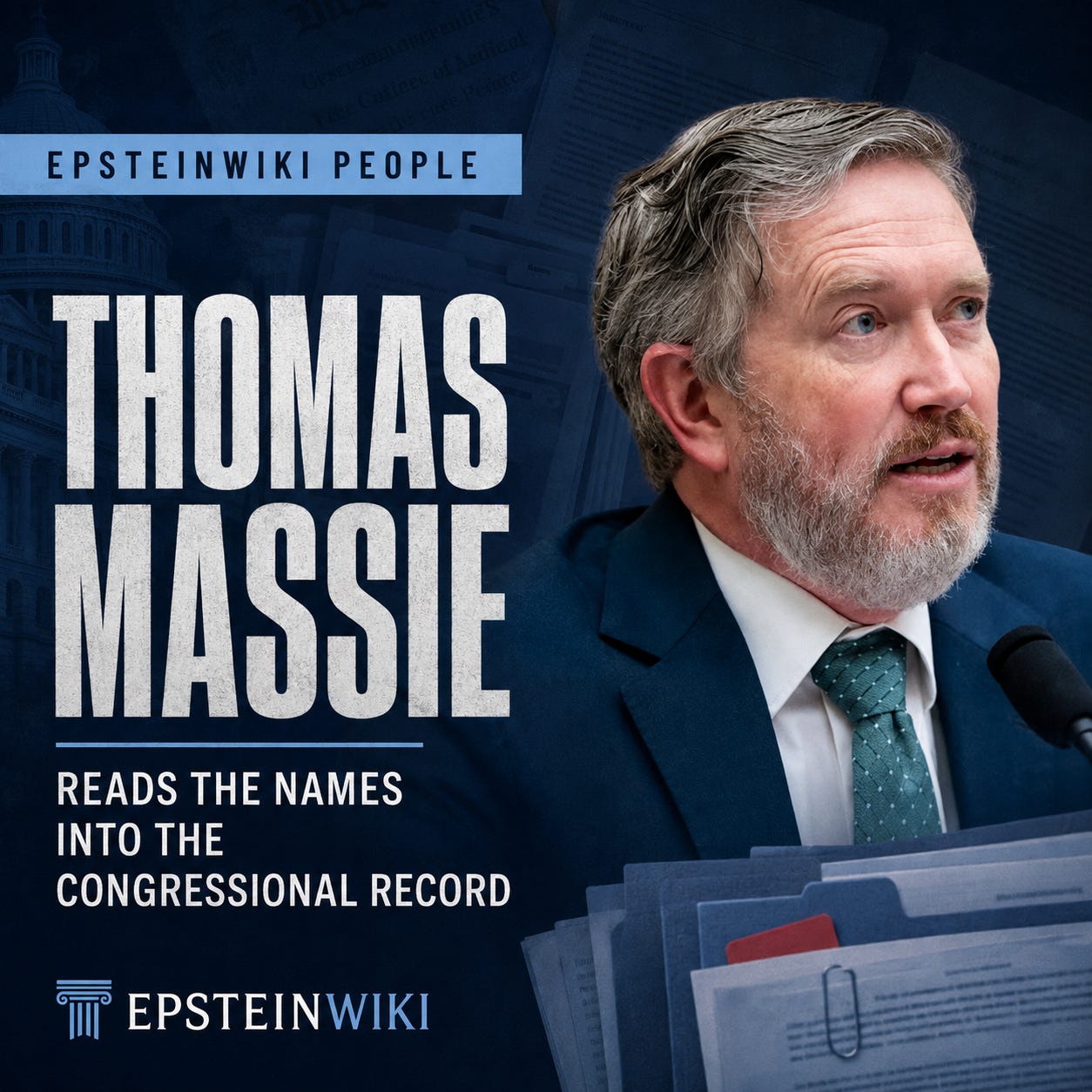
A member of Congress publicly identified fourteen people he says should be investigated and prosecuted while demanding a vote on the Epstein Files Transparency Act II.
On August 31, 2026, Representative Thomas Massie stood on the floor of the United States House of Representatives and did something the Department of Justice has spent years avoiding.
He read the names.
Massie identified fourteen people he described as Jeffrey Epstein “co conspirators” who should be investigated and, where supported by evidence, prosecuted. He then launched a discharge petition intended to force a House vote on the Epstein Files Transparency Act II.
The speech was dramatic. The names were consequential. But the most important question remains the same one EpsteinWiki asks every day:
What do the records actually show?
Massie’s statement is not a criminal indictment, judicial finding, or jury verdict. Several people he named have denied wrongdoing, and many have never been charged with an Epstein related crime. A name appearing in Epstein’s communications, address books, flight records, testimony, or photographs does not automatically establish criminal conduct.
However, Massie was not merely reading a celebrity contact list. He was demanding that federal investigators examine people whose names, relationships, communications, financial dealings, employment, or alleged conduct appear across the Epstein record.
That demand deserves scrutiny, context, and receipts.
Watch Thomas Massie Read the Names on the House Floor
The complete video of Massie’s remarks can be watched below.
As direct reporting on Massie’s speech documents, Massie argued that publicly stating the names might pressure the Department of Justice to act.
“Perhaps hearing these names will shame the Department of Justice into delivering justice,” Massie said.
The shame should not come from naming people without evidence. It should come from possessing millions of pages of evidence while refusing to explain clearly who was investigated, what investigators found, why particular cases were closed, and why so much material remains withheld or heavily redacted.
The Fourteen People Massie Named
The descriptions below explain how each person fits into the public Epstein record. Inclusion does not establish guilt. It establishes that Massie publicly called for investigation and that the person has a documented or alleged connection requiring careful examination of the underlying evidence.
1. James “Jes” Staley
Jes Staley was a senior JPMorgan executive who maintained an extensive relationship with Epstein while Epstein was a client of the bank. Emails, regulatory proceedings, civil litigation, and congressional testimony have examined the nature of that relationship.
Staley has denied knowing about Epstein’s criminal activity and denied some characterizations of their relationship. He has not been convicted of an Epstein related crime. The public record nevertheless contains enough documented communication, travel, banking activity, and contradictory descriptions to justify serious examination.
2. Leon Black
Leon Black paid Epstein enormous sums for tax, estate, and financial advice after Epstein’s 2008 conviction. Black has said he deeply regrets his relationship with Epstein and has denied involvement in Epstein’s criminal conduct.
The Senate Finance Committee investigation examined Black’s payments, financial arrangements, and explanations. Those records make the relationship an evidence question, not celebrity gossip.
3. Les Wexner
Les Wexner gave Epstein extraordinary authority over his finances, properties, and business affairs. Epstein held power of attorney for Wexner and acquired the Manhattan townhouse that later became central to survivor accounts and criminal investigations.
Wexner has said he severed ties with Epstein and denied knowledge of Epstein’s crimes. The scale of Epstein’s access, authority, and financial benefit remains one of the most important unresolved relationships in the case.
4. David Copperfield
David Copperfield appears in witness testimony and records describing social encounters connected with Epstein. Johanna Sjoberg testified that she met Copperfield at a dinner at Epstein’s residence and that he asked whether girls were aware that other girls were being paid to recruit them.
Copperfield has denied awareness of Epstein’s criminal activity. The testimony documents what Sjoberg said under oath. It does not constitute a criminal finding against Copperfield.
5. Lapo Elkann
Lapo Elkann is a member of Italy’s Agnelli family. His name appears within the expanding record of Epstein’s European business and social connections.
The linked EpsteinWiki investigation discusses related international evidence rather than serving as a dedicated Elkann profile. Identification and context must be verified against the original documents because some Epstein records use first names, incomplete references, or ambiguous identifiers.
6. Tom Pritzker
Tom Pritzker, executive chairman of Hyatt Hotels Corporation, appears in Epstein related testimony and records. Virginia Giuffre made an allegation involving Pritzker, which he denied.
The existence of an allegation in sworn testimony establishes that the allegation was made. It does not establish that a court or jury found it true. That distinction is precisely why investigators must compare testimony with travel records, communications, schedules, witnesses, and other contemporaneous evidence.
7. Glenn Dubin
Glenn Dubin and his family maintained a documented relationship with Epstein. Records and testimony have examined social connections, household interactions, financial relationships, and allegations involving people within the Dubin household.
Dubin has denied allegations of sexual misconduct and has not been convicted of an Epstein related offense. His appearance in the record requires the same disciplined approach applied to everyone else: identify the document, classify the evidence, record the denial, and determine whether independent corroboration exists.
8. Frédéric Fekkai
Frédéric Fekkai appears in Epstein related social, contact, and documentary records. A documented association is not proof of participation in trafficking or abuse.
Massie’s decision to name Fekkai creates an immediate need for Congress and the Justice Department to identify which records formed the basis for including him. Public accountability requires more than a name. It requires disclosure of the supporting evidence.
9. Edoardo Teodorani Fabbri
Edoardo Teodorani Fabbri appears in communications and records connected with Epstein’s European network. The linked EpsteinWiki investigation supplies related social network context rather than a complete standalone profile.
His inclusion by Massie should prompt a focused review of Epstein’s communications, meetings, introductions, and travel involving European business and aristocratic circles. Frequency of contact can establish a relationship, but investigators must determine what the relationship involved.
10. Jean Luc Brunel
Jean Luc Brunel was a French modeling agent accused by multiple women of helping Epstein obtain access to young women and girls. Brunel was arrested in France and faced criminal proceedings involving allegations of rape and sexual harassment.
Brunel denied wrongdoing. He died in a French jail in 2022 before the charges could be adjudicated at trial. His death ended the prosecution, but it did not erase the witness statements, modeling industry records, travel, communications, or allegations surrounding his relationship with Epstein.
11. Daniel Siad
Daniel Siad was a modeling industry figure whose communications with Epstein included discussions about young women and introductions. EpsteinWiki has documented emails and records concerning Siad’s role in supplying Epstein with access to women through international modeling networks.
Massie identified Siad during the speech and described him as deceased. His death does not eliminate the value of examining his communications, contacts, introductions, and relationships with other people in Epstein’s network.
12. Ramsey Elkholy
Massie named Ramsey Elkholy, but EpsteinWiki does not currently have a verified standalone profile for him. A search of the existing site can be conducted through the EpsteinWiki search results for Ramsey Elkholy.
Until a complete evidence page is published, claims about Elkholy should be tied directly to authenticated documents. Massie’s statement establishes that a member of Congress called for his investigation. It does not explain the full evidentiary basis or establish criminal responsibility.
13. Andrew Mountbatten Windsor, formerly Prince Andrew
Virginia Giuffre alleged that Epstein and Ghislaine Maxwell trafficked her to Andrew when she was seventeen. Andrew denied the allegations.
Giuffre sued Andrew in federal court. The case ended in a settlement without an admission of liability before Andrew was deposed. Other witnesses, including Johanna Sjoberg, also made allegations involving him.
Released FBI records such as EFTA00269896 and EFTA00269967 preserve investigative accounts involving Andrew. Those records show that allegations were reported to investigators. They are not criminal judgments.
14. Lesley Groff
Lesley Groff worked for Epstein for years and handled scheduling, communications, travel arrangements, and logistics. Her role has been examined through emails, survivor accounts, litigation, and congressional questioning.
Groff has described herself as a victim of Epstein’s manipulation and denied knowingly participating in trafficking. Several survivors have challenged parts of that account.
The released congressional transcript of Groff’s testimony allows readers to examine her answers rather than relying on a viral summary. Massie went considerably further, accusing Groff from the House floor of conspiring with Epstein to traffic women. That is Massie’s allegation, not a judicial finding.
This Was Not a Client List
The fourteen names should not be repackaged as an authenticated “Epstein client list.”
Massie described them as co conspirators and called for investigation and prosecution. Congress has not adjudicated the evidence against them. The Justice Department has not announced charges against most of the people named. Some appear in sworn allegations, some in financial records, some in emails, some in social evidence, and some in multiple categories.
Those are not interchangeable forms of evidence.
A flight record can show travel. It cannot establish what happened at the destination.
An email can establish communication. Its meaning depends on language, context, surrounding messages, and corroboration.
A deposition can establish what a witness said under oath. It does not establish that every statement was accepted as true.
A congressional speech establishes what a member of Congress alleged. It does not function as a conviction.
That is why the documents matter more than the spectacle.
Why Massie Is Forcing Another House Vote
Massie’s speech was connected to a larger legislative fight over the Justice Department’s handling of the Epstein files.
The official announcement of the Epstein Files Transparency Act II explains that H.R. 9694 would allow survivors, state attorneys general, authorized state officials, and members of Congress to challenge the Attorney General in court over records that are unlawfully withheld, concealed, delayed, removed, or improperly redacted.
The bill would also:
Give survivors access to complete records concerning themselves and the harm they reported, including relevant FBI FD 302 interview reports.
Provide state and local prosecutors with unredacted records needed for investigations and prosecutions.
Allow legal challenges to Justice Department noncompliance with the original transparency law.
Apply existing federal penalties when officials knowingly conceal, destroy, falsify, withhold, or misrepresent covered records.
Prevent the Justice Department from using certain common law privileges to evade the original disclosure requirements.
Massie introduced the legislation with Representatives Ro Khanna and Teresa Leger Fernández. Senators Jeff Merkley and Ben Ray Luján introduced the Senate effort.
The bill’s supporters say the Justice Department continues to withhold more than three million responsive files while maintaining excessive redactions in other released records.
Massie’s discharge petition is intended to bypass congressional leadership and force the legislation onto the House floor if it receives 218 signatures.
The Receipts Must Be Public
Massie has now placed fourteen names into the national conversation. The Justice Department still holds the responsibility to explain what its investigators found.
That does not mean dumping survivor information onto the internet. The federal government has already failed survivors through careless redactions and releases that exposed private information while continuing to conceal institutional decisions.
Real transparency protects survivors while revealing:
Which alleged participants were investigated.
Which witnesses were interviewed.
Which subpoenas were issued.
Which financial transactions were examined.
Which charging recommendations were made.
Why prosecutors declined particular cases.
Which records remain withheld and under what lawful exemption.
The Epstein Data research database allows the public to search the released Justice Department production. Its congressional deposition archive provides searchable testimony, while Hear from the Survivors keeps the people harmed by Epstein at the center of the record.
The documents should drive the investigation. Survivor testimony should guide its moral purpose. Fame, wealth, political affiliation, and proximity to power should protect no one from legitimate scrutiny.
The Names Are Only the Beginning
Massie’s floor speech created a moment. Whether that moment produces accountability depends on what Congress, prosecutors, journalists, and the public do next.
Reading fourteen names into the congressional record is not justice.
Releasing lawful evidence, protecting survivors, explaining prosecutorial decisions, investigating corroborated allegations, and bringing supported cases before a court would be justice.
EpsteinWiki will continue building the record person by person, document by document, and claim by claim. Every profile links readers back to the evidence so that no one must choose between government secrecy and reckless internet accusations.
The names are now public.
The receipts must follow.
Sources and Further Reading
Sayer Ji’s report on Massie’s floor speech provides direct coverage, the complete list, and video context.
Law Commentary’s report documents the date, fourteen names, discharge petition, and important legal caution that Massie’s statements are allegations rather than criminal findings.
Thomas Massie’s official Epstein Files Transparency Act II announcement explains H.R. 9694 and the proposed enforcement provisions.
Massie’s House floor video preserves his remarks and the language he used when naming the fourteen people.
R. Howard Stone’s Sleuthsletter supplies broader independent reporting and context concerning the Epstein Files Transparency Act and the continuing disclosure fight.
American Freakshow’s examination of Justice Department handling provides independent background concerning federal control of the Epstein files and the political accountability surrounding their release.
Epstein Data document search provides direct access to the searchable Justice Department production and should be used to verify names against original EFTA records.
Epstein Data congressional depositions provides searchable legislative testimony and official source links.
Epstein Data survivor archive collects public interviews and statements from survivors in their own words.
Lesley Groff’s congressional transcript contains her testimony and should be read before drawing conclusions about her statements.
Senate Finance Committee materials concerning Leon Black document the committee’s continuing investigation into Black’s financial relationship with Epstein.
Senator Ron Wyden’s Wall Street and Epstein report examines financial institutions, transactions, compliance failures, and unresolved investigative questions.
Giuffre v. Maxwell contains the central civil discovery record behind many Epstein related depositions and exhibits.
Giuffre v. Prince Andrew contains the complaint, motion practice, scheduling orders, and settlement record.
United States v. Maxwell contains the federal criminal proceedings that resulted in Maxwell’s conviction.
I is about time to throw some chum in the water and expose this massive cover up.
And Melania, and Gary King and all the New Mexico Epstein Protector officials, and all the Pro Zio Epstein Protector politicians?